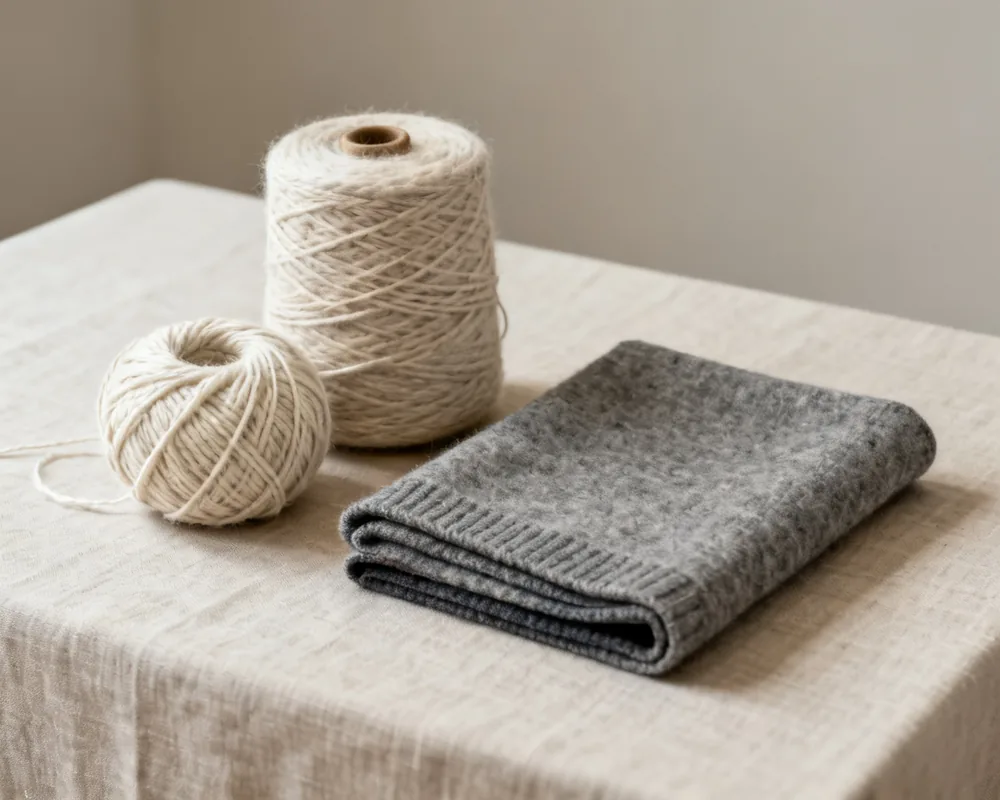
Natural fibres
Cotton and wool change the way an apparel brief should be written. Cotton yarn is often discussed through count, staple character, and how the eventual cloth will be washed. Wool yarn raises handle, moisture response, and care limits that a shirt-washing cycle may not respect. A natural-fibre sentence needs the blend percentage if any other fibre is present, because a wool-rich blend and a wool-look cloth are not the same material.
Synthetic fibres
Polyester, nylon, and viscose change drying, strength, and the way a finish sits on the yarn or the cloth. Those traits are reasons to ask a narrower question, not reasons to declare a winner. If a recycled input is part of the buyer’s target, the request should ask for the declaration that actually covers this lot. A general fibre brand name is not that declaration.
Keep the comparison inside one object
A tradeoff is readable only when both sides describe the same kind of object. Comparing a wool yarn cone with a finished polyester shirting roll mixes linear density, cloth mass, and finish history. Split the file. On the yarn side, record composition and count. On the cloth side, record composition, GSM, usable width, and finish. Then ask which care route the garment will actually see. A wool cloth that is dry-cleaned and a cotton cloth that is home-laundered can both be appropriate, and neither result is an environmental score for the company name on this website.
Processing scope is the next limit. Dyeing, compacting, singeing, or a mechanical finish can change hand and dimensional behaviour. If the buyer cares about those steps, the enquiry should say whether they are inside the comparison or outside it. Leaving them unnamed makes two cloths look interchangeable when only the fibre line matches. The same caution applies to sewing thread bought beside the cloth: thread composition does not describe the shell fabric.
Care and end-of-use stay as questions
Use and care change what “appropriate” means. Pilling on a knit, shrinkage on a shirting, and shine on a suiting are garment problems. They should be tied to a specimen and a care description. End of use is narrower still. A buyer may want to know whether a blend can be mechanically recycled in a route that actually exists for that blend. This page does not confirm that such a route is available, and it does not describe a take-back program. The honest step is to ask which recovery path, if any, the supplier can document for the construction being bought.
Document scope sits beside every wording choice. If someone offers a standard name, a recycled-content claim, or a wool-scheme name, ask for the holder, the product coverage, and the date. Do not copy the scheme name into a product title until that check is done. Vardhman, as used here, marks the enquiry subject. It is not presented as a certificate, a farm claim, or a mill inventory.
Hand and abrasion are a second split. A softer wool handle can matter for suiting, while an abrasion or pilling note matters when the cloth will be rubbed in wear. Each needs its own specimen. Stock selection still has to name the lot and the date it was checked. Custom development still has to name the sample and the approval gate. A coated face and a laminated film answer different peel and add-on questions, and this apparel-yarn page does not rank them. A target such as 180 g/m² or a 30 tex yarn is a briefing number, not an environmental score.